

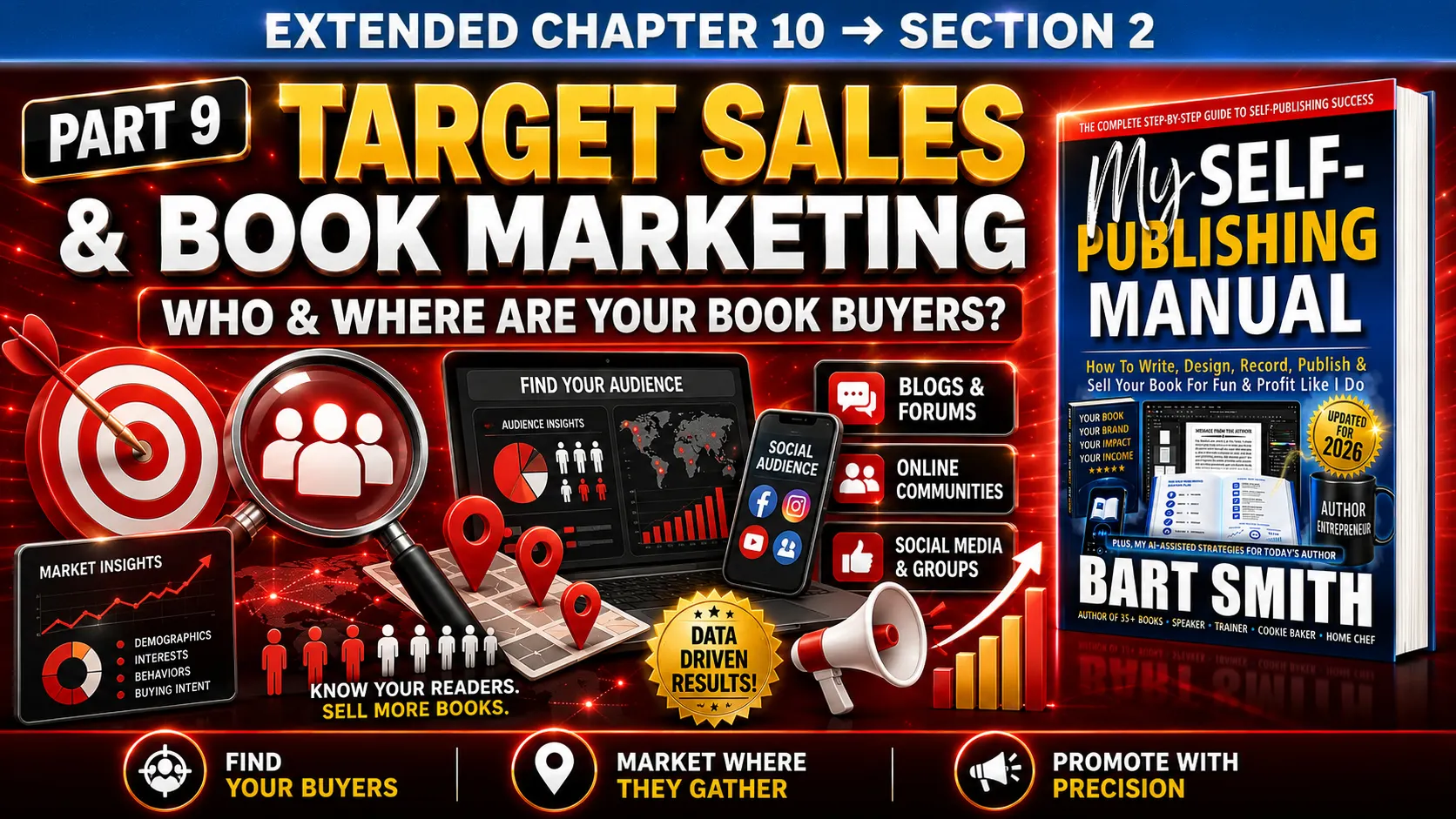
SECTION 2 → PART 9
Target Sales & Book Marketing: Who & Where Are Your Book Buyers? Let's Go Find 'Em!
EXTENDED BOOK CHAPTER #10 from MY SELF-PUBLISHING MANUAL by Bart Smith
INTRODUCTION & WHAT TO DO
Who is your target market? I’m sure you thought about that before writing a single word, right? Now it’s time to identify exactly who your ideal readers are, what they care about, what problems they want solved, and where they already spend their time online and offline.
Your book buyers are not hiding. They are gathering somewhere. They are reading certain websites, watching certain YouTube channels, joining certain groups, following certain influencers, listening to certain podcasts, attending certain events, subscribing to certain newsletters, and searching for answers related to your topic.
Your job is to find those places, study them, and then show up with the right message.
Before you start spending money on ads or randomly posting “Buy my book!” online, make a master list of at least 50 to 100 places where your ideal readers can be found. This list becomes your book marketing map. It tells you where to pitch interviews, post content, run ads, offer excerpts, contact influencers, submit guest articles, look for partnerships, and promote your book with far more precision.
Where To Find Your Ideal Book Buyers
Start researching places like these:
1. Facebook Groups — Search for active groups related to your book topic, audience, problem, hobby, industry, lifestyle, profession, or niche.
2. LinkedIn Groups & Profiles — Look for professional communities, topic-based groups, company pages, influencers, and decision-makers who serve or represent your audience.
3. Reddit Communities — Search for subreddits where people ask questions, share frustrations, recommend resources, and discuss the exact topic your book covers.
4. YouTube Channels — Identify channels that already attract the type of people who would benefit from your book. Study the comments, video topics, and creators who might be open to interviews or collaborations.
5. Podcasts — Find shows that interview authors, experts, coaches, consultants, business owners, creators, or people in your niche. These can become powerful interview opportunities.
6. Blogs & Article Websites — Look for blogs that publish guest posts, book recommendations, expert interviews, resource lists, or educational content related to your topic.
7. Email Newsletters — Find newsletter publishers who already communicate with your target audience. Some may accept guest articles, sponsor messages, interviews, or resource mentions.
8. Online Forums & Communities — Search for niche forums, private communities, discussion boards, Discord groups, Slack groups, Skool communities, and membership sites where your readers gather.
9. Influencers & Content Creators — Make a list of people who already speak to your audience on YouTube, Instagram, TikTok, LinkedIn, podcasts, blogs, or newsletters.
10. Associations & Organizations — Look for trade associations, nonprofit organizations, professional groups, clubs, unions, alumni groups, and industry organizations connected to your topic.
11. Conferences, Expos & Trade Shows — Identify events where your target audience attends, learns, networks, buys products, and looks for solutions.
12. Local Businesses & Community Hubs — Depending on your topic, consider bookstores, coffee shops, libraries, coworking spaces, wellness centers, schools, churches, chambers of commerce, networking groups, hobby shops, and local event venues.
13. Bookstores & Libraries — Look for local, regional, independent, specialty, and niche bookstores or libraries that may host author talks, book signings, workshops, or reading events.
14. Schools, Colleges & Training Centers — If your book teaches something useful, educational, motivational, career-related, creative, or professional, explore schools, adult education programs, colleges, and training organizations.
15. Meetup & Event Groups — Search for local or virtual gatherings where people already meet around your topic, industry, hobby, personal goal, or professional interest.
16. Amazon Review Sections — Study reviews on books similar to yours. Readers will tell you what they liked, what they wished was included, what confused them, and what they still need help with.
17. Competing Author Websites — Study where other authors in your niche are appearing, who interviews them, what websites link to them, what events they attend, and what audiences they serve.
18. Social Media Hashtags — Search topic-related hashtags on Instagram, TikTok, LinkedIn, Facebook, and X to find conversations, creators, and communities connected to your book.
19. Q&A Websites — Look at sites like Quora or other question-based communities where people ask questions related to your topic. Those questions can lead to articles, videos, excerpts, and promotional angles.
20. Businesses That Serve The Same Audience — Find companies, service providers, coaches, consultants, product sellers, software providers, or brands that already serve the people who would benefit from your book.
Build Your Book Buyer Map
As you research, create a simple spreadsheet in Excel or Google Sheets or a document with a table and columns like:
1. Name of website / group / podcast / organization
2. Website link
3. Contact person
4. Email or contact page
5. Audience type
6. Possible opportunity
7. Notes
8. Date contacted
9. Follow-up date
Your goal is not to find one perfect place to promote your book. Your goal is to build a working map of many places where your ideal readers already are.
CLOSING THOUGHTS & YOUR EXECUTION PLAN
Once your book buyer map is built, start working it. Do not let that list sit in a file and collect dust. Begin reaching out to the websites, podcasts, YouTube channels, newsletters, groups, organizations, events, influencers, businesses, and media outlets that already serve the kind of people who would benefit from your book.
Pitch yourself for interviews. Offer guest articles. Share helpful excerpts. Suggest joint promotions. Ask about speaking opportunities. Submit your book for review. Offer to teach a short workshop. Run targeted ads where appropriate. Comment intelligently in communities. Show up where your readers already are, and give them a clear reason to notice you, trust you, and learn more about your book.
This is targeted book marketing. Instead of shouting into the open Internet and hoping the right people hear you, you are walking directly into the rooms, websites, shows, groups, events, and communities where your book naturally belongs.
Now take action. Pick your first 10 places from your list, contact them, track your outreach, follow up, and keep going. The more precisely you understand your audience and where they gather, the easier it becomes to promote your book with confidence, consistency, and purpose.
CHECK OUT OTHER BOOK MARKETING LESSONS
← PREVIOUS LESSON (PART 8)
MAIN BOOK MARKETING HUB
NEXT LESSON (PART 10) →

© BartSmith.com | All Rights Reserved
Website Design & Marketing by Bart Smith